

Content
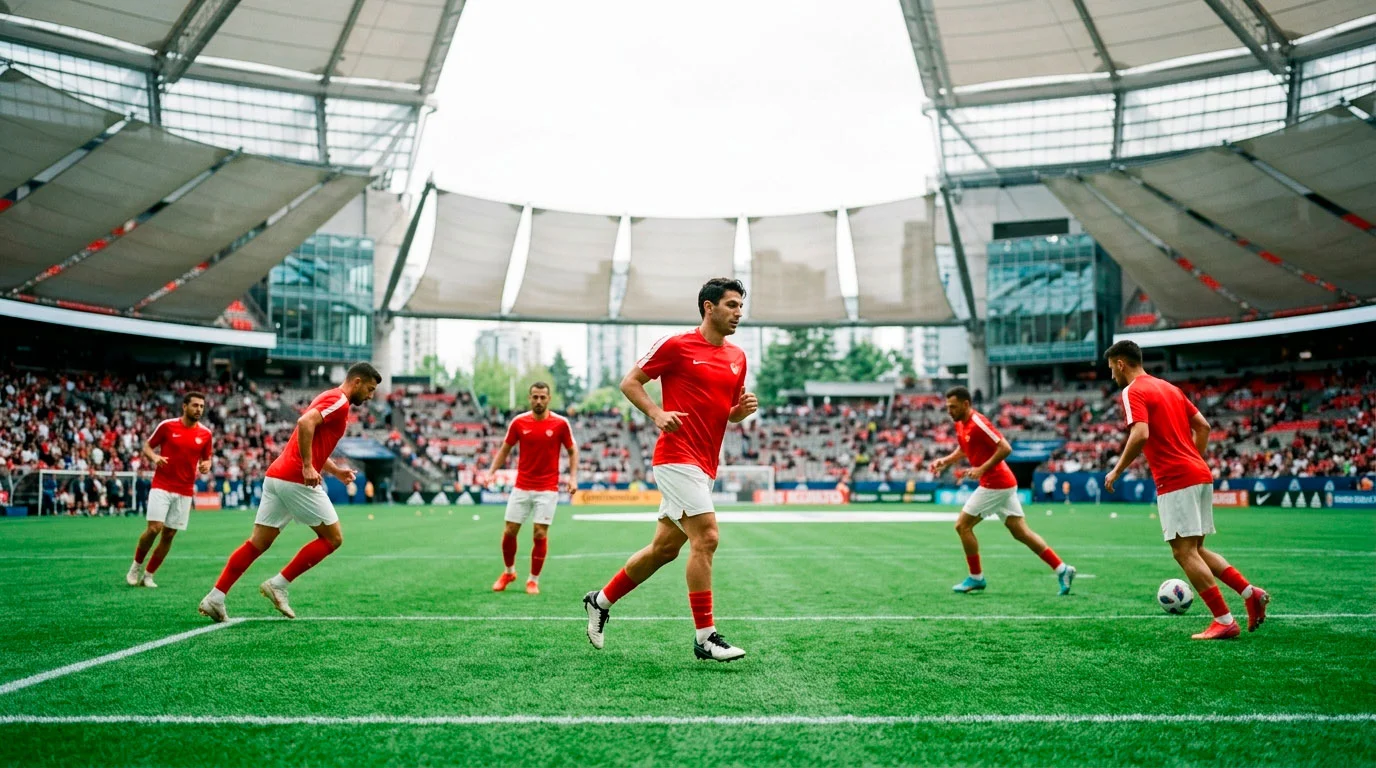
13 June. 2:00 pm Saturday arvo AEST. BC Place, Vancouver. The Socceroos vs Türkiye. This is where it starts — not just for Australia’s tournament, but for the punting campaign that could fund your winter. I have circled this match on the calendar since the group draw landed in December, because it is the kind of fixture that separates sharp punters from casual ones: two evenly matched sides, one with tournament experience (Australia at Qatar 2022), the other returning after a 24-year absence (Türkiye since the 2002 World Cup where they finished third). The pricing will be tight, the data will be contested, and the value will be hiding in the margins.
Türkiye’s return to the World Cup is a story of patience rewarded. The generation that produced Hakan Sükür, İlhan Mansız, and Rüştü Reçber — the heroes of the 2002 bronze-medal campaign — has been replaced, rebuilt, and replaced again across a cycle of near-misses that tested Turkish football’s sanity. Euro 2008 semi-finals, then nothing. Euro 2016 group exit. Euro 2020 group exit. Euro 2024 quarter-finals. And finally, through the UEFA play-off route, qualification for the 2026 World Cup. For Aussie punters, understanding what this 24-year drought does to a team’s mentality is essential to pricing the opening match correctly.
Türkiye’s Long Road Back: 24 Years of Waiting
The last time Türkiye played at a World Cup, George W. Bush was in the White House, camera phones did not exist, and the Socceroos were four years away from their own World Cup return in 2006. That kind of gap creates institutional amnesia — the current squad has zero World Cup experience, the coaching staff have never managed a World Cup match, and the federation’s operational knowledge of how to run a World Cup campaign has evaporated through two decades of absence.
Türkiye qualified through the UEFA play-offs after finishing third in their qualifying group behind France and the Netherlands. The play-off route took them through a tense semi-final against Wales (won on aggregate via a late goal in the second leg) and a Final against Hungary that went to extra time before a 2-1 victory in Budapest. The play-off matches revealed a team that is capable of producing big performances under pressure but struggles to maintain consistency across a multi-match sequence. In the qualifying group proper, Türkiye’s record was 5 wins, 2 draws, and 3 losses — a W-L record that placed them behind the two group heavyweights but clearly above the rest.
The underlying data from qualifying is mixed. Türkiye’s xG-for of 1.67 per game was respectable but not dominant, reflecting an attack that creates chances in bursts rather than through sustained pressure. Their xG-against of 1.12 was the concerning number — significantly higher than what you would expect from a team with aspirations of World Cup knockout-round qualification. The defensive vulnerability was most evident in transition: when Türkiye lost possession in the opponent’s half, the counter-attacking exposure was severe, with opponents generating 0.34 xG per counter-attack versus the UEFA average of 0.21. For Socceroos punters, that transition weakness is critical information — Australia’s 3-4-3 system is specifically designed to exploit opponents who press high and leave space in behind.
The Euro 2024 quarter-final run, though ultimately ended by the Netherlands (2-1), provided a more encouraging data set for Türkiye’s World Cup chances. In that tournament, Türkiye beat Georgia 3-1 and Czechia 2-1 before losing to Portugal 3-0 in the group stage and then producing their best performance — a round of 16 win over Austria — before the Dutch ended their campaign. The Austria match was instructive: Türkiye absorbed pressure, defended deep, and counter-attacked with devastating speed through their wide players. That was the version of Türkiye that can compete at the World Cup. The Portugal match — where they were overwhelmed from the first minute — was the version that will struggle.
Key Players: Who the Socceroos Need to Worry About
Arda Güler is the name on every scout’s lips. The attacking midfielder, still just 21 during the tournament, possesses a left foot that can change a match in a single moment — a dipping free kick from 25 metres, a curling shot into the top corner, a through ball that splits three defenders. His Euro 2024 goal against Georgia was one of the strikes of the tournament, and his ability to produce individual brilliance from minimal opportunities makes him the most dangerous player the Socceroos will face in the group stage. Güler’s club situation — wherever he is playing by June 2026 — will determine his match fitness, but his talent is beyond dispute. For the Socceroos’ defensive structure, Güler represents the primary threat: he occupies the number 10 space between Australia’s midfield pivot and back three, and if the Socceroos cannot press him consistently, he will hurt them.
Hakan Çalhanoğlu operates from deeper, typically as a regista in a 4-2-3-1 or the right side of a midfield three. His passing range — both short combinations and long switches of play — is the mechanism through which Türkiye progress the ball from defence to attack. Çalhanoğlu’s set-piece delivery is among the best at the tournament: his free kicks carry dip, swerve, and accuracy, and his corner delivery has generated goals throughout his club career. For punters eyeing the BTTS market in Australia vs Türkiye, Çalhanoğlu’s dead-ball quality is a factor that supports the “Yes” side. Even if Australia dominate open play, a single Çalhanoğlu free kick from 22 metres could equalise.
In attack, the flanks are where Türkiye generate their most dangerous moments. The wide options — a combination of pacey wingers who have developed through the Turkish Süper Lig and European club football — provide the direct running that exploits the space behind advancing wingbacks. If Australia’s wingbacks push high (as the 3-4-3 demands), the Turkish wingers will have one-on-one opportunities against the wider centre-backs — a matchup that could produce goals from either side. The centre-forward position has been a rotating door, with no single striker establishing undisputed ownership. That inconsistency in the number 9 role suppresses Türkiye’s goals-per-game average and is the primary reason they underperformed their xG in several qualifying matches.
Defensively, Türkiye’s goalkeeper Altay Bayındır will face significant pressure if called upon. The centre-back pairing has varied across the qualifying cycle, and the lack of a settled defensive partnership is a vulnerability that Popovich’s coaching staff will have identified. Set pieces — Australia’s strongest attacking weapon — are where Türkiye’s defensive disorganisation is most likely to be punished. The Socceroos’ corner routines generated nine qualifying goals from dead-ball situations, and Türkiye’s aerial vulnerability (they conceded four headed goals in qualifying, the highest among UEFA play-off qualifiers) creates a direct avenue for Australian scoring.
Australia vs Türkiye: The Group Opener That Defines Everything
There is a rule I apply to every World Cup group: the opening match determines the trajectory. Win the first game, and your probability of qualification jumps from roughly 50% to 75%. Lose it, and you are fighting for survival in the remaining two matches against opponents who smell blood. Draw it, and you are treading water — alive but not comfortable. For both the Socceroos and Türkiye, the 13 June match at BC Place in Vancouver is the most important 90 minutes of their World Cup campaigns.
The tactical matchup is fascinating. Australia’s 3-4-3, with its aggressive wingbacks and three-man attack, creates a high-risk, high-reward structure that generates chances at both ends. Türkiye’s most likely setup — a 4-2-3-1 with Güler behind a single striker — is more conservative but relies on Güler’s creativity to unlock defences. The contrast in approaches suggests an open first half as both teams seek an early advantage, followed by a more cagey second half as the team that leads protects the result. That pattern — fast start, slow finish — points to the “first half over 1.5 goals” market as a potential value play if priced at 2.80 or above.
The venue itself adds context. BC Place is a retractable-roof stadium with an artificial surface, which reduces the advantage of technical teams (the ball moves faster on synthetic turf, making precise passing slightly harder) and benefits direct, physical teams. Australia’s style — direct wingback play, set-piece emphasis, aerial duels in the box — is better suited to the surface than Türkiye’s possession-based approach. If the roof is closed (likely in June for temperature regulation), the enclosed atmosphere will amplify crowd noise — and Australian fans, travelling from the substantial expat community in Canada’s West Coast, could create a genuine second-team advantage.
The betting case for Australia in this match rests on three pillars: Türkiye’s 24-year World Cup absence (which introduces nervousness and unfamiliarity), Australia’s set-piece dominance (which exploits Türkiye’s aerial weakness), and the artificial surface at BC Place (which suits direct play). If the H2H market prices Australia at 2.80 or above to win, that is a value bet. The draw at 3.20-3.40 is also playable. And BTTS “Yes” at 1.80-1.90 is the goals-market position I would take, based on the combined attacking profiles and the transitional nature of both teams’ defensive setups.
A brief cultural note: Australia and Türkiye share a unique historical connection through the Gallipoli campaign of 1915, a relationship that has evolved from conflict into mutual respect. The sporting encounter on 13 June will carry an undertone of that shared history, and both sets of fans will likely acknowledge it. For Türkiye’s players, the occasion adds emotional weight to an already pressurised debut match — and emotion, in betting terms, is a destabilising factor that increases variance and the probability of unpredictable outcomes.
Türkiye Odds: What the Market Says
Türkiye’s outright odds to win the World Cup will be in the 81.00-101.00 range — longshot territory that reflects their ranking, their qualifying route, and their 24-year absence. There is no value case for backing Türkiye to win the tournament. The value lies entirely in the group-stage and match-level markets.
Türkiye to qualify from Group D (top 2 or best third) will likely be priced at 3.00-3.50. My fair price is approximately 3.20, implying a 31% probability. The case for qualification rests on beating Paraguay and getting a result (win or draw) against either Australia or the USA. If Türkiye win the opener against the Socceroos, their qualification probability jumps to approximately 55%, making them live contenders for second place. If they lose, it drops to roughly 15%, and the campaign is effectively over.
For match-level markets, the key Türkiye fixture for punters is not the Socceroos opener (where the pricing will be tight and the value marginal) but the Paraguay match — the fixture most likely to produce a clear-cut value opportunity. Türkiye vs Paraguay is a match between two returning sides with similar profiles: both lack World Cup experience, both qualified through difficult routes, and both play transitional football that produces open, unpredictable matches. The H2H market on that fixture will likely be the closest to 50-50 of any Group D match, and the draw at 3.20-3.50 is the value lean.
The Aussie Punter’s Angle on Türkiye
Türkiye are not a team to fear — they are a team to respect and exploit. Respect the attacking talent (Güler, Çalhanoğlu), respect the emotional intensity of a team returning after 24 years, but exploit the defensive vulnerabilities, the set-piece weakness, and the lack of World Cup experience that will manifest in nervous moments during tight matches. The Socceroos have every tool needed to beat this team on 13 June: the tactical structure, the set-piece quality, and the tournament experience. What they need is the execution — and that, ultimately, is what you are betting on when you back Australia in the opener.
My recommended positions: Australia H2H at 2.80+, BTTS “Yes” at 1.80+, and over 2.5 goals at 2.00+. If all three land, you are looking at a slip that pays itself many times over. And even if only one hits, the Saturday arvo in June just got a lot more interesting.
For a complete view of how all Group D teams stack up and the Socceroos’ overall World Cup picture, visit the 48-team punter’s guide.
